
I recently bought a car. As you can imagine, I was knee-deep in statistics. At one point, I wasn’t sure whether I was going to get an SUV or a pickup truck and could recite from memory the clearance height of my top five list. It turned out comparing them wasn’t nearly as straightforward as I thought.
At one dealership, I asked a salesperson, “What is the capacity of this pickup?”
Before you read any further, think about how you might have answered. Did you think about how much it can tow? How much weight it can carry in the bed? How many passengers can fit?
She didn’t answer my question. She asked one.
"Capacity of what?"
It struck me that I had asked a rather ambiguous question. A pickup truck doesn't have a single capacity. It has a towing capacity, a payload capacity, a passenger capacity, and a cargo capacity. Each with its own assumptions.
I realized that we ask the same question in manufacturing every day.
Leaders want to know:
How many gallons can we produce in a month?
Can we grow 20% next year?
How much capacity do we have left?
What percent of our capacity do we actually schedule?
Everyone expects one number. The problem is that it is impossible to answer any of these questions without making a whole heap of assumptions.
Before you continue reading, let’s pause for a moment. If someone asked you, "Can this plant produce another 20% next year?" what questions would you ask before answering?
How many shifts?
The same product mix as last year?
Any new products?
How many changeovers each day?
How much planned maintenance?
What is the average run rate?
If I asked five different manufacturing leaders the question, their lists of questions would overlap, but not completely. Then their answers would almost certainly differ. None of them would necessarily be wrong. They just started from different assumptions.
That's why two experienced manufacturing leaders can calculate two very different capacities for the same production line and both believe they're right.
Manager A assumes three shifts because that's what the line is capable of running. Manager B assumes two because that's what's staffed today. Manager A assumes last year's product mix. Manager B assumes the new product launching next quarter.
Neither is lying. Neither is bad at math. They simply started with different assumptions.
The disagreement usually isn't in the math.
It's in the assumptions.
The Capacity Stack
The easiest way to think about capacity is to stop thinking about it as a single number.
Every manufacturing asset begins with 168 available hours each week. For the Capacity Stack, the starting point is 168 hours of the fastest product. The same approach can be used for a month, quarter, year, or any other planning period.
From there, every capacity difference is converted to hours. Running two shifts instead of three reduces hours directly. A slower product mix reduces output, and that difference can also be converted to hours. The same is true for losses from rate, quality, and other operating performance. This gives every capacity assumption a common unit of measure.
Throughout this article, a capacity loss simply means productive hours lost. Some losses are intentional business decisions. Others are not.
It can be helpful to consider capacity as layers.
The first layer consists of decisions that shaped how the company designed the operation to run.
The second reflects how the company chose to use that operation during a particular planning period.
The third measures how much capacity was lost while executing the plan.
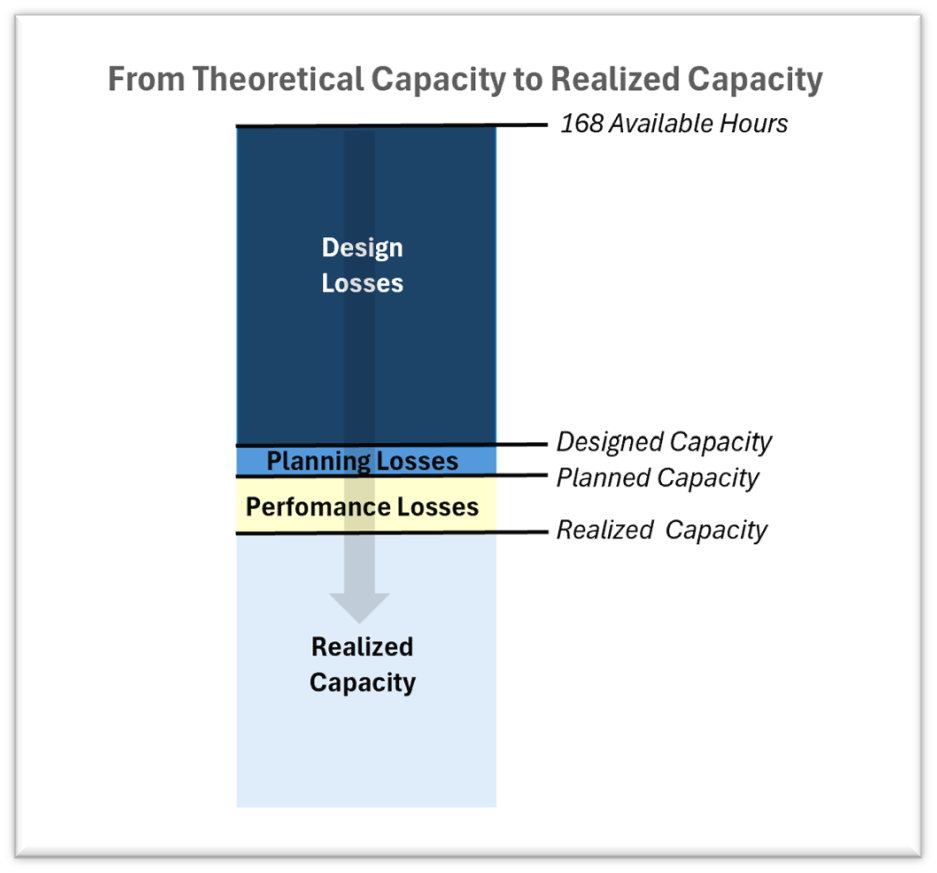
Figure 1. The Capacity Stack: every capacity calculation is the result of design decisions, planning decisions, and operational performance.
Calculating capacity is usually not the hardest part. Making all the assumptions visible is.
The Capacity Stack makes those assumptions visible by separating them into three layers.
Layer 1: Designed Capacity
The first layer of assumptions consists of the decisions that shaped how the company designed and set up the operation.
Examples include:
Number of shifts staffed vs hours available in the period
Planned staffing changes for the period
Planned overtime
The lines and assets that run each shift
Following a product wheel to minimize changeover times
Planned maintenance
Stopping or running through breaks and lunches
These decisions establish the boundaries within which everything else operates.
Layer 2: Planned Capacity
The first layer established the operating boundaries. The second layer reflects how the company chose to follow those boundaries (or not) during a particular planning period.
Examples include:
Which products were scheduled
The planned production sequence vs the standard sequence
Planned campaign lengths
Planned changeover time (number of changeovers × expected length)
Unlike the first layer, these assumptions can change every week or every month. They don't redefine the operation. They define how the company adapts based on current demand and operating conditions.
During planning, it is often necessary to make decisions that cost capacity.
Layer 3: Realized Capacity
The first layer defined the operation. The second layer defined the plan. The third layer reflects what actually happened.
Examples include:
Actual vs. planned run rates, yield, and uptime
Changeovers that take longer than planned
Additional changeovers caused by schedule break-ins
Unplanned and expedited orders dropped into the production schedule
Customer order changes
Absenteeism
The schedule represents the company's best prediction of how its assets and resources will be employed.
Reality usually has other plans.
The third layer measures how closely actual performance matched the plan. Over time, it can show how predictable the operation really is.
Once a company makes the assumptions at each level explicit, a capacity calculation becomes what it always should have been:
A math problem instead of a crystal ball.
Then, if the answer to the math problem isn't what the company hoped for, the next step isn't to argue about the number. It's to examine the assumptions behind it. Some assumptions may simply be wrong and need to be corrected. But if the assumptions accurately describe the operation and the company wants a different capacity result, changing the assumptions on paper won't produce it.
Something in the real world has to change too.
I worked with one client where management added what they called “the wedge” to the annual plan. It was additional production (and sales) added to the budget without changing the assumptions that supported the original capacity number. The company would “figure it out” during the year. Every monthly report included the budget plus the wedge.
The wedge changed the number. It didn't change the operation.
Every assumption represents an expectation about how the company will operate. And if something changes in the real world, the assumptions should change too. A well-managed operation knows when reality and current assumptions no longer agree or when the desired results aren't aligned with how the operation actually runs.
When the company wants to change an assumption to achieve a different capacity result, leaders should expect a concrete plan explaining what will make the new assumption achievable, how long it will take, what it will cost, and what risks it introduces. Otherwise, the leader must challenge whether the new assumption is achievable. An updated assumption without a plan is just wishful thinking.
Because capacity doesn't improve when the assumptions change. Capacity improves when the operation changes.
Which brings us back to the dealership.
"Capacity of what?" wasn't a dodge. It was the only honest answer to an incomplete question.
Manufacturing deserves the same honesty. The next time someone asks, "What's the capacity?"
Start with, "It depends."
Then agree on the assumptions before anyone starts doing the math.